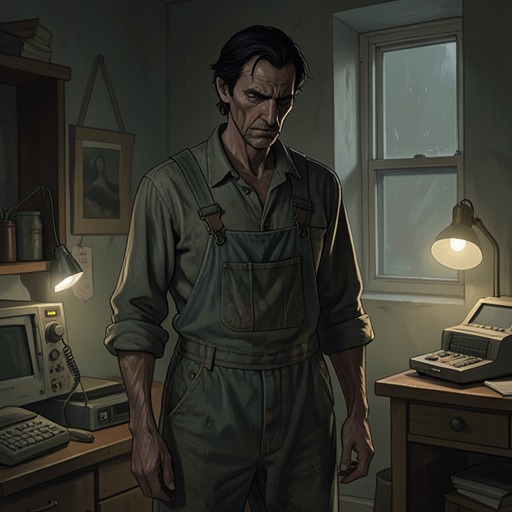
Ronny's Will
The Hanging GirlRonny's Will transforms a family gathering after Ronny's cremation into a public trial of Carl Mørck. In the statement enclosed with it, Ronny claims that he killed his father and that Carl knowingly helped him; he also directs that what remains of his estate after his wife's share goes to Carl. Read aloud among grieving relatives, the document makes the dead man's voice an instrument of accusation, inheritance, and disruption, while leaving the truth of its most damaging claims sharply contested.
Occasion and Form
Ronny's death has not made him predictable. At Restaurant Hedelund, where Carl once gave the first and only speech of his life at a family celebration, the relatives gather again over open sandwiches and drinks. The earlier occasion had been a confirmation party; this one is more unpleasant, though the room and its efforts at conviviality make the passage of time seem temporarily suspended. Ronny has already been taken to the crematorium, but Carl expects trouble from him even now, imagining that someone will soon produce a paper and detonate the accusations Ronny has prepared.
The statement arrives through a family attorney, who has asked a second cousin to read a brief text enclosed in the will. Its delivery initially borrows the conventions of a toast: the reader announces that Ronny does not intend to intrude too much on the occasion, thanks the Hedelund staff, and invites the guests to raise their glasses to Ronny. Most laugh and toast politely. Carl does not. The light manner is not incidental: it makes the transition from social nicety to accusation more abrupt, and turns the family’s expected ritual of remembrance into a scene Ronny appears to have arranged from beyond the grave.
Ronny’s written voice presents itself as if speaking from a newly acquired Buddhist temple. He begins by calling himself a party animal and asking for a quick toast, then moves almost immediately to his hatred of his father and his admission of responsibility for the man’s death. The reader’s formal role is simply to relay the text, but in the room that act gives Ronny’s words a force the absent author cannot personally supply. The document speaks in Ronny’s name; the relatives must respond in person.
The Murder Claim
The central allegation is that Ronny killed his father. In the statement, he says that he hated him and then claims, “I killed him, might as well just say it how it is in front of this closed company.” The phrasing makes the admission sound deliberately blunt, while the reference to a closed company frames the gathering as an audience to a disclosure Ronny has chosen to stage after his death.
Ronny does not leave the accusation at a bare confession. He says he has described the circumstances in detail in his will, then attributes the method to knowledge he acquired from Carl. According to the statement, Carl taught him karate, so Ronny knew how and where to strike his father to paralyze him without leaving an identifiable sign. He says he let the man tumble into a river and left him there. These are specific allegations about planning, physical technique, and concealment, but the will’s account is still Ronny’s account: its force in the room does not itself establish that the events happened as described.
The claim also reaches beyond Ronny’s own responsibility. He says Carl looked away and thanks him for doing so, presenting the cousin not as an uninformed relative but as a knowing accomplice. Ronny adds that if Carl denies the allegation, he will be lying, and says that memoirs he has sent to major publishers will make their shared involvement clear. The will thus carries two related threats: it exposes Carl to the family immediately and points toward a wider public reckoning through Ronny’s claimed memoirs.
The Inheritance and Carl’s Denial
The bequest binds accusation to reward. Ronny says that he leaves Carl everything remaining after his wife has taken her share, and asks the guests to raise their glasses to the cousin who supposedly helped him get rid of his father. The toast makes the inheritance sound less like a private disposition of property than the final stroke in Ronny’s public humiliation of Carl: accepting the estate would be inseparable, in the statement’s telling, from being named as the beneficiary of a concealed crime.
The relatives’ reactions make the accusation immediate and collective. Carl’s father shouts for the reader to stop, while Ronny’s brother Sammy insists that he has a right to know what the statement means because the dead man was his father too. As the reader continues, the room falls into a silence Carl experiences as the calm before a storm. The document has shifted the gathering from polite commemoration to conflict among people who must decide, in public, whether to believe the words attributed to the dead.
Carl answers by denying the account. He calls it rubbish and says he remembers the day, but was walking over to two girls standing beside their bicycles at the side of the road; he says he did not see what happened to Ronny’s father. This is his version, not a resolution supplied by the scene. Ronny’s statement anticipates denial and brands it a lie, while Carl’s denial challenges the statement’s authority. The gathering offers no neutral procedure for settling the contradiction; instead, Carl is left to face the consequences of one account being read aloud before the other can be tested.
Posthumous Force and Limits
The will’s power comes partly from its timing and setting. Ronny cannot be questioned after the cremation, yet his words arrive with the apparent deliberateness of a message prepared for a family audience. His claim to have sent memoirs to publishers extends that message beyond the room, and the bequest makes Carl’s personal stake unmistakable. Carl fears not only that his relatives will turn against him, but that the allegation could damage his police career and permanently cast him as an investigator who had once been an accomplice to murder.
That fear is a consequence of the accusation, not proof of it. The text shows the will creating suspicion, forcing Carl into an immediate defense, and threatening his standing both within his family and in public life. It does not, in this scene, independently verify Ronny’s account. The distinction matters because the statement is most effective as an act of posthumous pressure: it controls the room’s attention, defines the terms of Carl’s response, and links that response to a threat of publication. Ronny’s Will therefore functions not just as a record of his final claims, but as the mechanism by which he attempts to keep a concealed family history active after his death.